

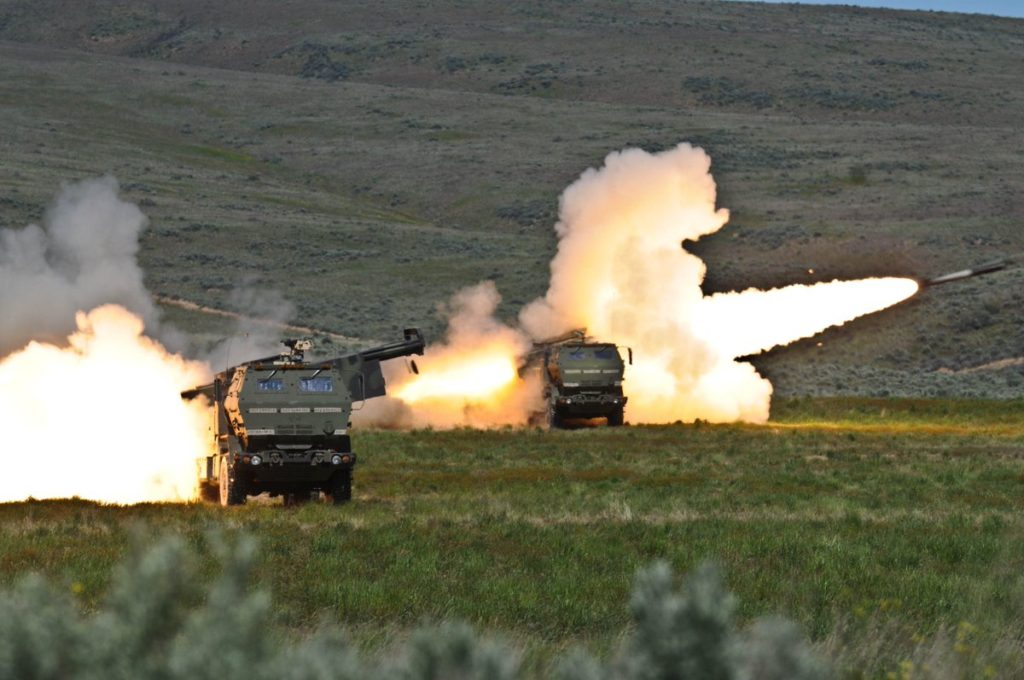
The United States has two multiple launch rocket systems that matter in this war: the M270 MLRS and the M142 HIMARS. Both have a crew of three. Both fire the same missiles. Both can compute their own fire missions without relying on a distant headquarters to do the math. They are self-contained killing machines.
The M142 HIMARS exists in one version. The M270 comes in three, but only one matters for Ukraine: the M270A1. The old A0 can’t fire the GPS-guided missiles America uses now. The new A2 is packed with technology so sensitive that the Army won’t let it leave American hands. But the A1 is available. And as the Army takes delivery of new A2s, the A1s are being retired. Hundreds of them. Sitting in inventory. Waiting for a mission.
The math is simple. The US has more than 450 HIMARS in active inventory, with about 335 in front-line units. The rest are available. The M270A1 fleet numbers in the hundreds as well. Lockheed Martin can build more. The industrial base is humming. There is no shortage of launchers.
Now consider what these systems can do compared to what the Russians have.
The Russian Uragan takes more than twenty minutes to reload. The Smerch takes more than forty. The Russians have to measure their firing positions, plot missions on outdated maps, sight their launchers optically like it’s 1943. The result: one volley per hour at best.
The HIMARS and M270 reload in five minutes. They stop, receive coordinates from a drone, enter them into the fire control system, and launch. One minute from stop to shoot. Then they move. Five to six volleys per hour. The Russians cannot keep up. They cannot counter-battery what they cannot catch.
The range is officially seventy kilometers for GMLRS rockets. That’s the number the Pentagon puts in press releases. The real range is higher. How much higher I cannot say. But the Russians are about to find out the hard way.
And the accuracy. The M30A1 carries an alternative warhead that shreds everything in a large area with tungsten fragments traveling at Mach 3. The M31 and M31A1 carry unitary warheads for point targets. Both are guided by GPS. Both hit within a few meters of the aim point every time. The Russians measure accuracy in hundreds of meters. The Americans measure in single digits.
Now look at the front.
In Kherson, a single HIMARS or M270 can hit almost every Russian position in the oblast. More importantly, it can hit the choke points of Russia’s two supply lines: the Antonovskiy Bridge near Kherson and the Kakhovka Dam near Nova Kakhovka. Cut those, and the Russian forces west of the Dnieper are trapped.
In Kharkiv, the entire Russian supply line using the railway from Vovchansk to Kupiansk is in range. The Russian supply point at Kupiansk, which feeds the salient at Izyum, is in range. The Russians have massed logistics, command posts, ammunition depots, troop concentrations. They have done this because they believed Ukrainian artillery could not reach them. They were wrong.
The tactics are simple. Send up a drone. Find a Russian supply point. Hit it with an M30A1. Find a command post. Hit it with an M31A1. Find a battery. Give it a taste of both. Find infantry. One M30A1 covers them with 160,000 scorching hot fragments moving at Mach 3.
The crews don’t even have to get out of their vehicles to reload. The only risk is drones, which is why these systems need air defense close by. But for counter-battery fire? The Russians can shoot back all they want. Their shells will land long after the HIMARS is gone.
The author of this analysis, Thomas Theiner, knows what he’s talking about. Former Italian Army, living in Kyiv since 2009, expert on NATO Cold War forces. He says Ukraine needs at least forty-eight launchers, plus lots of missiles, plus drones to spot. Send them now, he says, and we can wrap this war up before Ukraine’s independence day.
Biden has said he will not supply long-range rockets that can hit Russia. That’s fine. The HIMARS and M270 don’t need to hit Russia. They need to hit Russian forces in Ukraine. And they will.
The Russians are about to make painful discoveries. The first is that their air defenses cannot stop these rockets. The second is that their logistics cannot survive these strikes. The third is that their tactics, based on mass and momentum, do not work when the mass is burning and the momentum is gone.
The Ukrainians have asked for these systems for months. Now they are getting them. The war is about to change.
