

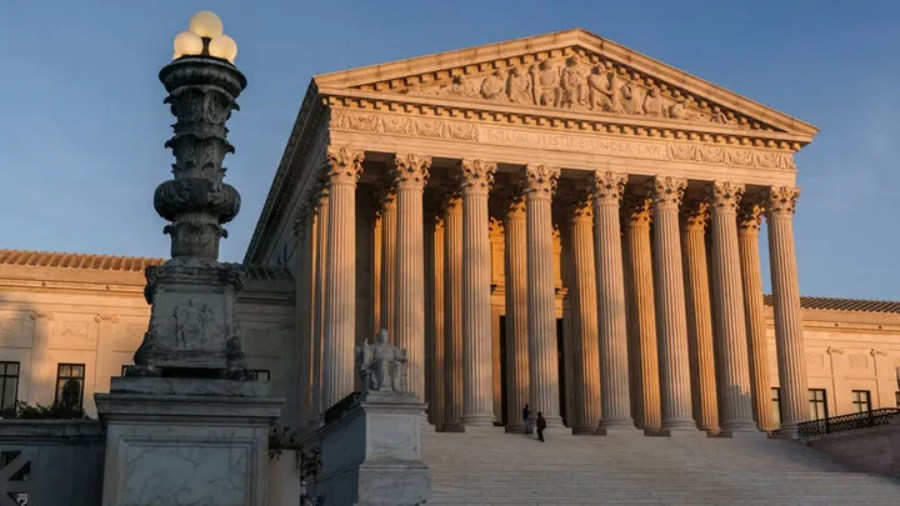
The future of mail-in ballot counting in American elections may hinge on a single question: What does “Election Day” actually mean?
That question sat at the center of a charged two-hour Supreme Court session Monday, as justices heard arguments in Watson v. Republican National Committee — a case that could determine whether states may continue counting mail-in ballots that arrive after Election Day, so long as they carry a valid postmark from on or before the election itself.
The court’s conservative wing appeared largely unconvinced that such state laws are legally permissible, signaling potential agreement with the Trump administration’s position and setting up a ruling with sweeping consequences for how American elections are conducted.
A decision is expected by June.
At the heart of the dispute is a 2024 Mississippi law that allows mail-in ballots to be received and counted up to five days after Election Day, provided they are postmarked by Election Day itself.
The Republican National Committee sued Mississippi over the statute, arguing that federal election-day statutes preempt state laws that extend the counting window beyond Election Day. The case eventually reached the Supreme Court, where justices were asked to determine whether federal law requires that ballots not only be cast — but also received — by Election Day.
Mississippi is far from alone in this practice. 14 states, the District of Columbia, and three U.S. territories currently operate under similar late-arrival provisions.
The oral arguments made clear that the court’s conservative bloc has serious reservations about broad state latitude in this area.
Chief Justice John Roberts pressed directly on the core definitional question, stating: “If Election Day is the voting and taking, then it has to be that day.” He also posed questions about whether the same reasoning could threaten early voting arrangements, asking whether the logic of the challengers “requires a different consideration” for early ballots — including whether a ballot submitted two weeks before Election Day would also raise concerns.
Justice Samuel Alito took perhaps the most textually rigid approach, arguing that “Election Day” should be understood as a single, specific day — not an open-ended window. Drawing an analogy to other calendar-based terms, he listed Labor Day, Memorial Day, and Independence Day as examples of phrases where “day” is understood as a precise point in time, not a range.
“I think this is the day in which everything is going to take place, or almost everything,” Alito said.
Justice Brett Kavanaugh echoed concerns about what delayed results could do to public trust in elections. “If the apparent winner the morning after the election ends up losing due to late-arriving ballots, charges of a rigged election could explode,” he said.
Justice Neil Gorsuch pushed the boundaries of the argument with pointed hypothetical questions, asking Mississippi’s lawyers how far states could theoretically extend their own deadlines if the court sided with the state. “If we were to rule against you, is there anything that would limit a state from allowing a receipt by election officials up until the day of the next Congress?” he asked.
Roberts and Barrett: The Potential Deciding Votes
While several conservative justices appeared firmly skeptical of Mississippi’s position, Chief Justice Roberts and Justice Amy Coney Barrett are seen as the potential deciding voices — and both used their time to press lawyers on both sides with demanding questions.
Their willingness to challenge both the challengers and Mississippi’s defenders suggests neither has fully committed to either outcome, and that the final ruling may turn on how the majority chooses to frame the legal boundary between state authority over elections and federal election-day statutes.
The case arrives against the backdrop of President Donald Trump’s sustained focus on mail-in voting during his second term in office. Trump has argued that mail-in ballot laws undermine confidence in election integrity, and previously signed an executive order seeking to end mail-in ballots in federal elections — an action that several Republican-led states have already acted on.
That executive order is a separate matter from the current Supreme Court case. But the administration’s position in Watson v. RNC is fully aligned with the RNC’s legal challenge.
U.S. Solicitor General D. John Sauer, arguing on behalf of the Trump administration, told the justices that Mississippi’s law and similar statutes in other states could erode voter confidence in the legitimacy of election results — a concern that resonated audibly with the court’s conservative members.
Mississippi Defends Its Law — and the Slippery Slope Questions Fly
Attorneys for Mississippi pushed back, arguing that the federal election-day statutes require only that voters cast their ballots by Election Day — not that officials receive them by that date.
“The election has then occurred, even if election officials do not receive all ballots by that day,” Mississippi’s lawyers told the court.
They also attempted to defend the law against the “slippery slope” hypotheticals raised by conservative justices, including questions about overseas service members and early voting — groups whose voting rights could theoretically be implicated depending on how broadly any ruling is written.
Paul Clement, presenting arguments on behalf of the Republican Party and Libertarian voters challenging the law, warned that a ruling favoring Mississippi would open the door to “limitless” state options. He suggested the logical endpoint of Mississippi’s argument could allow states to construct election systems where results are never truly finalized on Election Day itself.
“That seems to me to be a large reason why Election Day should mean ‘Election Day,'” Clement said.
The timing of the expected ruling — by June — places it squarely before the 2026 midterm elections, in which control of both chambers of Congress will be at stake.
A decision striking down Mississippi’s law, or broadly ruling that federal statutes require ballots to be received by Election Day, would force more than a dozen states to overhaul their mail-in voting procedures ahead of November. The downstream effect on voter participation — particularly in states where mail ballots routinely arrive after Election Day — could be significant.
The Republican National Committee framed the case in straightforward terms.
“Watson v. RNC is about a simple principle: ballots must be received by Election Day,” said Ally Triolo, communications director for the RNC’s Election Integrity efforts. “This prevents elections from dragging on for days and weeks after voters have cast their ballots, causing confusion and undermining our elections.”
A Court Already Deep in Election Law
Watson v. RNC is not the only high-stakes election case the Supreme Court is navigating this term.
Justices are simultaneously weighing cases involving the use of race in drawing congressional voting districts, as well as federal restrictions on how much money political parties may spend in coordination with candidates for Congress and the presidency.
The court’s workload on electoral matters reflects a broader national tension over the rules governing how Americans vote — and who gets to set them.
Whatever the Supreme Court ultimately decides in Watson v. RNC, the ruling will extend well past Mississippi’s borders.
For the states that currently count late-arriving ballots, a ruling against Mississippi would trigger an urgent scramble to revise laws before November. For voters who rely on mail-in ballots — particularly those in rural areas, those with disabilities, or those who mail ballots close to Election Day — the consequences could be direct and immediate.
The court’s conservative majority appears inclined to draw a harder line around what “Election Day” means. The question that remains is precisely how far that line extends — and who it leaves on the wrong side of it.
