

The poet Wilfred Owen, killed on the Western Front seven days before the armistice, wrote words that still cut to the bone: “For 14 hours yesterday, I was at work—teaching Christ to lift his cross by the numbers, and how to adjust his crown; and not to imagine he thirst until after the last halt.” He was describing the work of turning men into soldiers, of preparing them for the crucifixion that awaited. He knew what he was talking about. He died in the mud, at twenty-five, his poetry still in his pocket.
There are those who recoil from the idea that beauty can exist in the life of a combat soldier. They see only the pain, the loss, the wounds that scar for life. They do not see the comradeship. They do not understand the bonds formed in shared fear, the love that grows between men who have looked death in the face together and found each other still standing.
There are no better friends than those with whom you have been deeply and comprehensively afraid. That is a truth that cannot be explained to those who have not lived it. It can only be witnessed. In Spielberg’s film, Private Ryan says, “Go tell my mother that I will stay here, with the only brothers I have left.” That rings so true that it requires no explanation. Those ties bind unto death, until the last jump, as World War II paratroopers used to say.
War brings out the best and the worst in people. Men who would not cross the street to help a stranger in civilian life often fall in the effort to help near strangers in combat. The good things to be remembered all have to do with comrades.
Today we are served by professionals and militia soldiers of the National Guard and reserve. They bring to mind Lieutenant Colonel Fremantle’s description of Lee’s infantry at Gettysburg: “simply beyond praise.” A friend’s son is on his way back overseas for his fourth tour. Forty-five years ago, his father and I, looking down the barrel of another war, would never have believed we would see this. We were short-sighted. Plato said, “Only the dead have seen the end of war.” Perhaps he was right.
Some people write to me filled with high-minded attitudes about war. “That is why soldiers exist.” “Losses are worth their pain in a good cause.” I would say to such people: the soldiers already know that. They do not need your boosterism. They will do their duty to the last. Just let them get on with it without the indignity of your remarks.
After Vietnam, an Army chaplain said Mass one Memorial Day at the Presidio of Monterey. He was a Jesuit who had served in World War II, Korea, and Vietnam. He had served with infantry units, the people who do the serious, up-close killing and dying. Over ninety percent of combat deaths happen in the infantry.
He looked out at the congregation, mostly combat men and their families. He asked them to remember their brothers asleep in the Lord’s embrace. To remember how each man died alone, alone in fear, alone in misery, usually with no one to comfort him, often in the dark, with his life running out through mutilations that left little doubt of the outcome. He asked them to pray for the brothers who died for us all, as Jesus died for us all.
Nothing has changed. The wounds inflicted by modern weapons are appalling. Go to Walter Reed or Bethesda and see for yourself. The troops are not complaining. They never complain. And so nobody has any right to be less committed to the eternal mission of the soldier than they are.
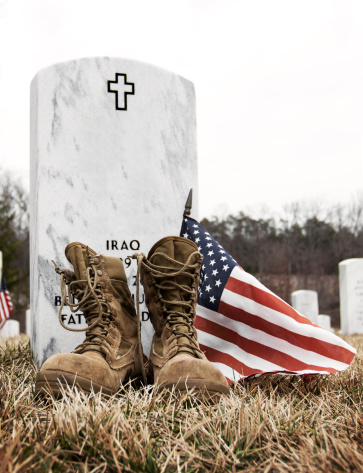
This Memorial Day, remember that the cemeteries and physical therapy wards are full of men and women who gave their all for you. They ask nothing more than to be allowed to go back and do it again. Pray for them.
Kipling wrote for the soldiers: “I have eaten your bread and salt. I have drunk your water and wine. The deaths ye died, I have watched beside, and the lives ye led were mine.” He called them “dear hearts across the seas.”
They are still there. Still dying. Still serving. Still asking for nothing in return.
Pray for them. Please.
