

Senate Republicans are marching toward a high-stakes floor battle over President Donald Trump’s signature voter ID legislation next week. But the biggest threat to the bill may not be coming from Democrats.
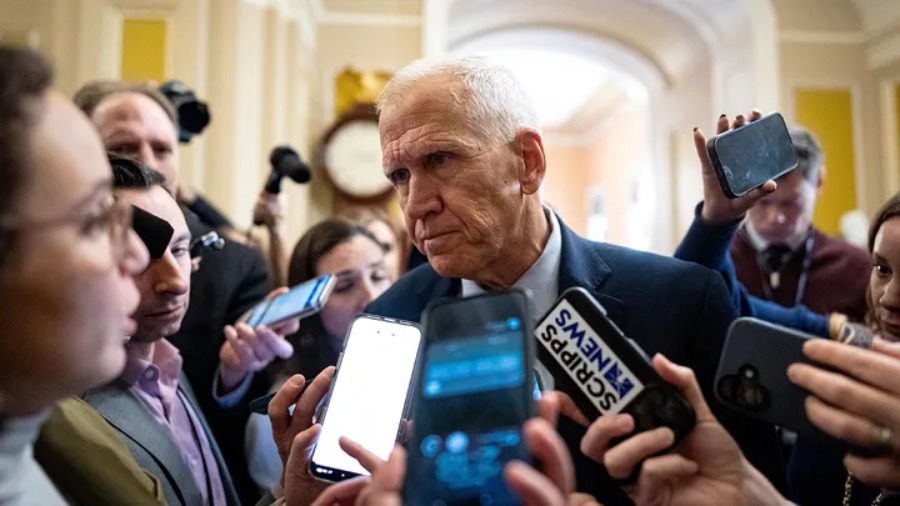
Sen. Thom Tillis (R-NC) announced Thursday that he will not only vote against the Safeguarding American Voter Eligibility (SAVE) America Act — he intends to actively fight its advancement.
“I’m a no,” Tillis said bluntly. “I’m going to do everything I can to prevent it from even moving forward.”
That declaration puts Republican leadership in an increasingly difficult position as the vote approaches.
Tillis isn’t opposed to voter ID in principle. He was, in fact, a co-sponsor of the bill’s earlier version — also called the SAVE Act — before the White House introduced sweeping changes to the legislation.
Those additions became a sticking point. The revised bill now includes a ban on mail-in ballots with narrow exceptions, a prohibition on transgender athletes competing in women’s sports, and a halt to gender-affirming surgeries for minors — provisions Tillis argues were inserted without proper consideration of state-by-state political and procedural realities.
“Taking the language from the White House without understanding the state-by-state implications, politically and procedurally, just doesn’t sound like we’re letting the people at the tip of the spear define what we should be voting on next week,” Tillis said, referring to Republican senators facing re-election.
He proposed an alternative approach: legislation that would incentivize states to adopt voter ID practices by tying compliance to federal funding, while directing non-compliant states’ money toward election integrity oversight instead.
“Who could be against that?” Tillis said. “Rock on, California, if you want to enable ballot harvesting — make sure you do it on your nickels.”
The Math Is Getting Uncomfortable for Republicans
Tillis’s opposition lands on top of an already fragile coalition.
Sen. Lisa Murkowski (R-AK) had previously declared she would not support the bill either, making her and Tillis the two Republican dissenters. Then came another blow: Sen. John Fetterman (D-PA) — who had occasionally broken with his party on high-profile votes — told CBS’s The Takeout with Major Garrett that he would not back the legislation in its “current state,” citing his objections to Trump’s position on mail-in voting.
That combination of Republican defections and a key Democratic holdout leaves GOP leadership with an extremely slim margin to even open Senate floor debate on the bill.
Senate Majority Leader John Thune (R-SD) and Republican leadership have already quietly acknowledged what the math makes obvious — the bill is unlikely to pass.
Rather than pursue a talking filibuster, which President Trump had pushed for and which would theoretically allow the bill to advance with a simple majority, Thune settled on a different approach. Republicans will bring the bill to the floor and load it with amendments, creating an extended debate marathon.
The strategy doesn’t lower the 60-vote threshold needed for passage. What it does do is force Senate Democrats — led by Minority Leader Chuck Schumer (D-NY) — into a series of difficult, on-the-record votes on voter ID, an issue Republicans believe works in their favor politically.
In short: the floor fight is less about passing a law and more about building a campaign message.
Trump’s Demand, and the Limits of Party Loyalty
Trump had explicitly called on Senate Republicans to ram the bill through Democratic opposition using a talking filibuster — a procedurally aggressive move that would have kept senators on the floor for extended periods and potentially cleared the way for a simple-majority vote.
Republican leadership pushed back, citing a lack of sufficient party unity to withstand Democratic amendment votes that could fundamentally reshape the legislation.
Tillis’s statement underscores just how far the internal divide runs. The tension between following White House directives and protecting vulnerable senators from difficult votes has surfaced publicly — and at a moment when Republican leadership can least afford it.
The Senate is expected to hold its vote on the SAVE America Act next week. Republican leaders appear to be proceeding despite knowing the outcome, betting that the political fallout for Democrats outweighs a legislative loss.
Whether that calculation holds — and whether any additional Republican or Democratic senators break ranks — will determine how damaging the episode ultimately becomes for both parties.
For now, one of the bill’s own former co-sponsors is its loudest opponent. That’s not the coalition-building story the White House was hoping to tell.
