

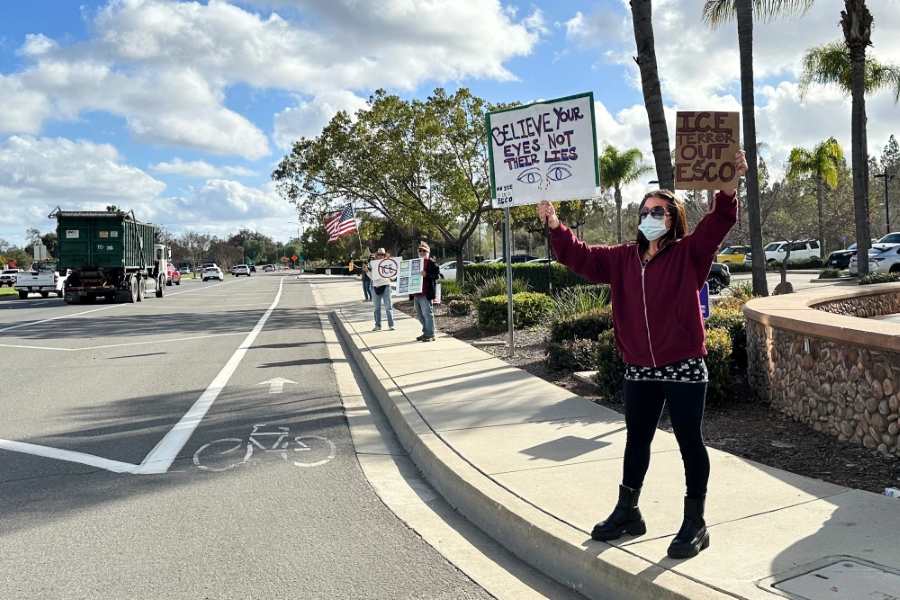
ESCONDIDO, Calif. — What once seemed like a quiet arrangement has exploded into heated protests as Escondido residents demand that the city end its long-standing contract allowing Immigration and Customs Enforcement (ICE) to use a local gun range for training purposes.
For over a decade, ICE officers have trained at the facility tucked away in the hillsides of Escondido, a suburban city just north of San Diego. However, the public remained largely unaware of the deal until the Trump administration’s aggressive immigration policies ignited widespread backlash. The fatal shootings of U.S. citizens by federal agents, combined with heightened scrutiny of local government cooperation with ICE, have intensified local opposition.
A series of rallies and protests has led to an outcry, culminating in a nearly five-hour City Council meeting. Hundreds of residents, holding signs that read “ICE Out,” filled the room, demanding that the city end its arrangement with ICE. Despite passionate pleas from protestors, the council narrowly voted to maintain the contract, with several members citing concerns over the impact on federal investigations into human trafficking and drug smuggling.
Widespread Backlash Over ICE’s Role in Local Communities
The controversy over ICE’s training in Escondido is part of a broader national movement challenging the agency’s growing presence in local communities. As the Trump administration’s immigration policies have faced increasing opposition, residents from New York to California are raising concerns over ICE’s use of local facilities. This includes everything from training ranges to office space. In some cases, ICE has plans to occupy massive detention centers that could hold thousands of immigrants, sparking alarm across communities that have felt blindsided by these developments.
In response to growing protests, Democrats in Congress have halted funding for the Department of Homeland Security and demanded stricter limits on ICE’s operations. This comes after recent deadly shootings of U.S. citizens, which have added fuel to the fire, further intensifying calls for reform.
Escondido’s relationship with ICE has historically been closer than in many other California cities. Before 2017, immigration officers worked alongside local police, even helping with vehicle stops and other law enforcement activities. However, California’s passage of a law limiting collaboration between local authorities and federal immigration agents ended this direct cooperation. Still, the arrangement allowing ICE to use the gun range continued, despite concerns about its impact on immigrant communities.
Protestors argue that this arrangement undermines public safety and trust in local law enforcement. They fear that news of the contract will make immigrants hesitant to report crimes or seek help from police, potentially putting their safety at risk. As the city’s Latino population represents roughly half of Escondido’s residents, the concerns are particularly resonant in this community.
Voices Against ICE’s Presence in Escondido
The conversation reached a boiling point during the City Council meeting, where residents voiced their concerns. Angela Spucces, a vocal protester, argued that the city’s relationship with ICE is about more than just a training contract—it’s about the values of local control and trust. “If we value community trust, we should draw the line now,” Spucces said, reflecting a growing sentiment that local control over police matters should not include allowing ICE to train in their communities.
While many voiced strong opposition to the training deal, a few residents, like Barry Speer, expressed support for maintaining the contract. Speer argued that limiting ICE’s access to training would hinder the agency’s ability to prepare for serious criminal investigations. “It doesn’t make sense to prevent them from training,” he said, underscoring the importance of ensuring that federal agents are well-equipped to address crime.
Details of the ICE Contract and Community Concerns
Under the agreement, signed by ICE in 2024 and renewed this year, Escondido receives $22,500 annually for up to three years in exchange for allowing ICE’s Homeland Security Investigations unit to use the range. More than 600 officers from 20 agencies use the site for training, including ICE. However, Police Chief Ken Plunkett emphasized that the city does not train with ICE, nor does it provide the agency with any specific resources—each agency brings its own equipment.
Despite this, the arrangement has stirred concerns that ICE’s use of the range will encourage further federal involvement in local law enforcement activities, especially at a time when communities are actively questioning the agency’s tactics and policies. The Department of Homeland Security, which oversees ICE, has declined to comment on the controversy, citing security concerns about the locations where agents are trained.
Escondido is not alone in facing opposition to ICE’s presence in local communities. Across the country, other cities have experienced similar debates. In Cottage Grove, Minnesota, residents have demanded an end to ICE’s use of a regional training facility, but local leaders argue that the facility cannot discriminate against public agencies due to its funding structure. In Islip, New York, residents called for the cancellation of a contract allowing ICE to use a rifle range, though local officials have decided to continue the deal. Additionally, Hartford, Connecticut, has chosen to end its contract with ICE for the use of a city-owned parking lot.
While some residents in Escondido support the contract, the debate has revealed a sharp divide in public opinion. Luke Beckwith, 26, expressed indifference, saying the revenue generated from the contract helps fund local services. “I personally don’t care,” he said. “It’s bringing revenue to the city.” However, many others, such as Richard Cannon, argue that allowing ICE into the community poses unnecessary risk. “By inviting ICE into our community, you are putting us at risk,” he said.
As the city continues to wrestle with whether to maintain or end the contract, it highlights a growing national debate over the role of federal immigration enforcement and its impact on local communities. The outcome of the City Council’s decision will likely set a precedent for similar battles in cities across the United States.
