

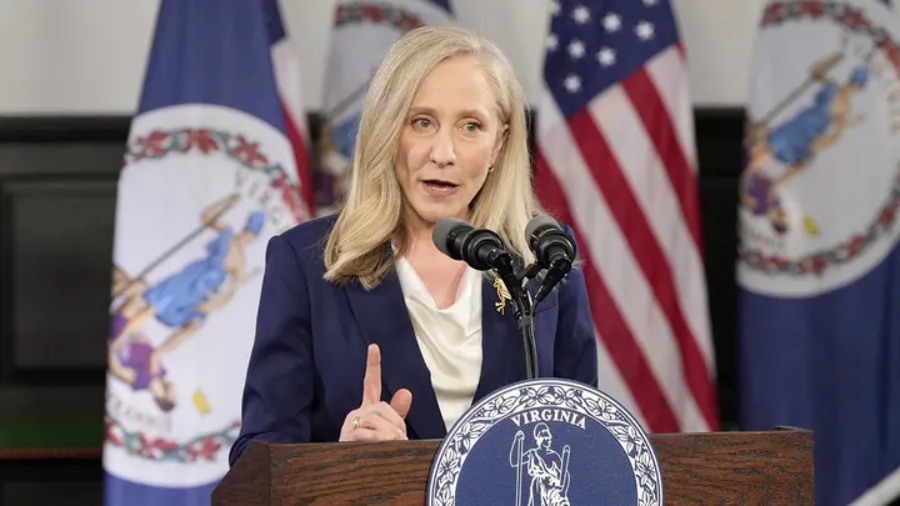
When Abigail Spanberger swept into the Virginia governor’s mansion last November, defeating then-Lt. Gov. Winsome Sears by a commanding 15 points, it looked like the beginning of a strong Democratic mandate in a state trending leftward. Less than three months later, the political picture looks considerably more complicated.
A new poll shows 46% of Virginians disapproving of Spanberger’s job performance, compared to 47% who approve — a near-even split that, in historical context, is striking. According to the data, Spanberger now holds the highest disapproval rating of any Virginia governor at this point in their term going back to 1994.
The historical comparison is particularly stark when placed alongside her immediate predecessor.
Republican Gov. Glenn Youngkin — who won his 2021 race by just 2 points over Democrat Terry McAuliffe — held a 54-39 approval rating at the equivalent point in his term. A governor who barely won is polling significantly stronger than one who won by a landslide.
The contrast extends further back across three decades of Virginia governors from both parties. Democrat Mark Warner — now Virginia’s senior senator — held the highest early-term favorability of anyone in the comparison period, at a remarkable 78-20. Sen. Tim Kaine stood at 62-31 at the same point. Republican Gov. Jim Gilmore III was at 63-30, GOP Gov. Bob McDonnell at 59-39, and Democrats Terry McAuliffe and Ralph Northam at 52-30 and 48-37 respectively.
Spanberger’s 47-46 split falls below all of them.
George Mason University Policy and Government Dean Mark Rozell, a co-sponsor of the poll, told The Washington Post that while some degree of partisan polarization is now “baked in” to any governor’s approval numbers, it was “unusual” to see results this low this early — particularly for a politician who had explicitly campaigned on a “centrist image.”
The Gerrymandering Reversal That’s Haunting Her
At the center of Spanberger’s political difficulties is an issue she once championed — and now appears to have abandoned.
In 2019, when Virginia was debating whether to strip map-redrawing power from the partisan legislature, Spanberger was an unambiguous advocate for reform. Her own words from that period are now being used against her.
“Gerrymandering is detrimental to our democracy and it weakens the individual voices that form our electorates. Opposing gerrymandering should be a bipartisan priority,” Spanberger wrote on social media at the time.
Critics of her current redistricting posture have been circulating those words in recent mailers, arguing that her actions as governor directly contradict the principles she once publicly championed. Spanberger’s office has denied that any internal deals were made involving her personally to benefit Democratic electoral prospects — including in the Second Congressional District covering Hampton Roads and the Eastern Shore.
The redistricting proposal itself has drawn independent criticism for its geographic design. Five newly drawn districts would originate in Fairfax County and extend outward in ways critics say would structurally dilute the political voices of voters in rural central and Western Virginia. One district in particular has been described by detractors as shaped like a lobster — and has already attracted three prominent Democratic candidates, including gun control bill sponsor State Del. Dan Helmer, former first lady Dorothy McAuliffe, and former Jack Smith deputy JP Cooney — despite the redistricting referendum not being formally decided by voters until April 21.
A Gun Policy Pivot That’s Drawing Fire
The gerrymandering controversy is not Spanberger’s only source of political friction. Her approach to gun control has also prompted criticism — particularly from moderates and conservatives who supported her based on her congressional record and personal background.
During her time in Congress and on the campaign trail, Spanberger consistently described herself as a pragmatic moderate on firearms — citing her experience as a former CIA agent and postal inspector who “carried a gun every single day” for her job.
“I’m a mother of three girls in Virginia Public Schools. I’m also a former federal agent who carried a gun every single day for my job,” she said at a 2025 rally. “So I come at this issue as someone who cares deeply about the safety of our kids and as someone who understands the responsibilities of owning and of carrying a firearm.”
Critics now argue that her gubernatorial posture tells a different story — pointing to her apparent willingness to sign sweeping firearms legislation drafted by far-left Fairfax Democrats, a significant departure from the measured, experience-grounded approach she emphasized as a candidate.
Notably, the poll found that just 7% of Virginians consider her tenure “too conservative” — suggesting that the disapproval is not coming primarily from the left, but from voters who expected her centrism to hold.
Gov. Abigail Spanberger entered office with more political capital than any Virginia governor in recent memory — a 15-point margin in a state that has trended competitive. The new poll suggests she has spent a remarkable amount of that capital in a very short time. Whether the early disapproval reflects genuine policy frustration, the inevitable gravitational pull of partisan polarization, or the specific consequences of a perceived shift on gerrymandering and gun rights will become clearer as the April 21 redistricting referendum approaches. What is already clear is that the cushion her landslide provided is thinner than anyone would have predicted three months ago.
Fox News Digital reached out to Spanberger’s office for comment and did not receive a response at time of publication.
