

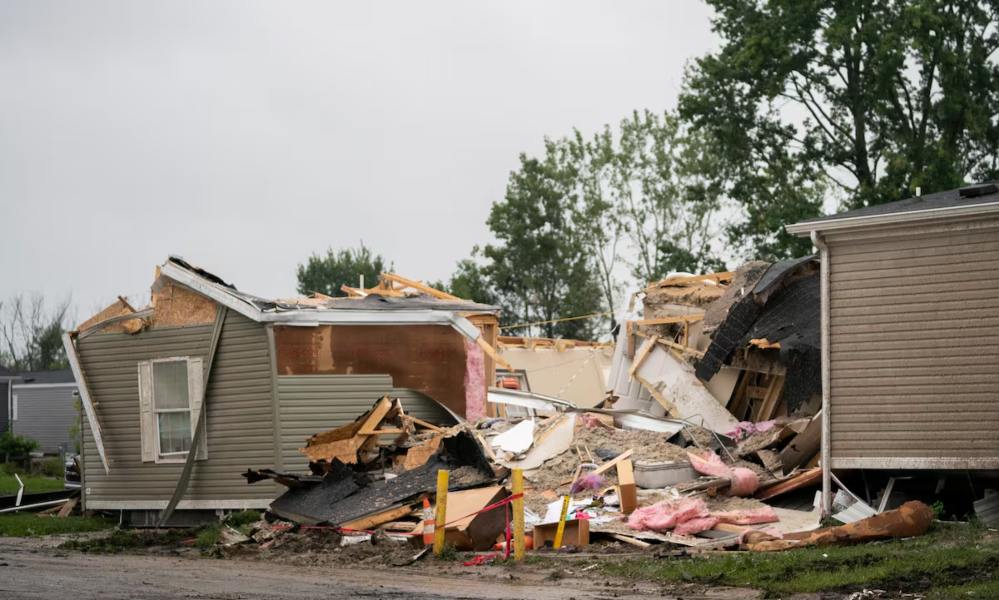
A deadly outbreak of severe weather descended on southern Michigan Friday, as at least one confirmed tornado — and possibly more — ripped homes apart, sent roofing materials airborne, and left tangled debris draped across power lines. By the end of the day, four people were dead and communities were left in shock.
The storms struck as part of a broad, violent weather system stretching from the Great Lakes all the way down to North Texas.
The heaviest toll fell on the Union Lake area, where the Branch County Sheriff’s Office confirmed three fatalities and 12 injuries following what appeared to be a direct tornado strike. Roughly 50 miles (80.5 km) to the southwest, Cass County officials reported one additional death and several more injuries after a separate tornado made contact with the ground.
The destruction was captured in real time by Lisa Piper, who stood on her back deck and filmed the chaos unfolding across a frozen Union Lake. A funnel cloud materialized before her eyes, then plunged toward the earth — uprooting trees and sending debris spiraling into the air.
“It’s lifting houses!” she cried out in the video. Moments later, her voice broke: “Oh my heart is pounding. Oh, I hope they’re OK.”
What Made Michigan So Vulnerable
The National Weather Service confirmed at least one tornado near Union City in southern Michigan and noted reports of possible additional touchdowns elsewhere in the state.
David Roth, a meteorologist at the weather service’s Weather Prediction Center in College Park, Maryland, explained the atmospheric mechanics behind the outbreak. A weather system drew moisture northward out of the Gulf of Mexico, accompanied by a warm front pushing into the region — where it then collided with the much colder air mass sitting over the Great Lakes.
That collision created ideal tornado conditions — and Michigan, while not tornado country by reputation, is no stranger to them. The state averages 15 tornadoes per year, a figure dwarfed by Texas (155) and Kansas (96), but significant enough to demand preparedness.
As storms continued their march across the state, the St. Joseph County Sheriff’s Office — located along the Indiana border — issued an urgent public warning, instructing residents to “seek shelter immediately.”
The alert cited reports of an unconfirmed tornado, an active severe thunderstorm watch, and possible wind gusts exceeding 60 mph (96.6 kph).
“Citizens should anticipate power outages, closed roadways and/or neighborhoods and cellular/internet interruptions,” the office warned in a Facebook post.
Oklahoma Tragedy: Mother and Daughter Among the Dead
The Midwest storm system claimed lives even before it reached Michigan. On Thursday night, near the western Oklahoma town of Fairview, a 47-year-old woman and her 13-year-old daughter were found dead inside a vehicle near a highway and county road intersection at approximately 10 p.m.
A first responder’s dashcam captured a striking and eerie scene: the officer drove directly toward the incoming storm as lightning illuminated a massive funnel cloud appearing to touch the ground — one of the first significant severe weather events of the approaching spring storm season.
Oklahoma Governor Kevin Stitt addressed the losses in a public statement Friday. “I am praying for the family as they grieve this tragic loss, as well as all those impacted by the storms,” he said.
The threat was far from isolated. The National Storm Prediction Center placed more than 7 million Americans under the highest level of severe weather risk Friday — a zone encompassing Kansas City, Missouri; Tulsa, Oklahoma; and Omaha, Nebraska.
A broader risk zone — affecting nearly 25 million people — extended to include Dallas, Oklahoma City, and Milwaukee, Wisconsin.
The National Weather Service warned that severe, scattered thunderstorms would continue rolling through Friday evening, targeting the Plains states, the Ozarks, and the broader Midwest.
The Start of Tornado Season — and a Record Heat Surge
This violent stretch of weather arrives near the traditional start of tornado season — a window that opens at different times across different regions of the United States.
Meteorological authorities recommend that all households establish a clear emergency plan ahead of tornado threats, including securing a weather radio and identifying a safe shelter location in advance. [Suggested Link: FEMA tornado preparedness guide]
While the Northeast began to see conditions ease Friday, six states — Maine, New Hampshire, Vermont, Massachusetts, Rhode Island, and Connecticut — remained under active weather advisories.
Across the southern US, the same weather pattern responsible for the storm outbreak is now expected to drive record-breaking warmth through the weekend. Federal forecasters projected temperatures running 20 to 30 degrees above average, with readings in the 80s°F reaching as far north as parts of the Ohio Valley and Mid-Atlantic.
“Daily records could become widespread,” federal forecasters wrote in their long-range forecast. Friday’s storms underscore a sobering reality heading into spring: severe weather season is here, it is active, and millions of Americans from the Gulf Coast to the Great Lakes sit in its path. With the combination of violent tornadoes, record heat, and ongoing storm threats, forecasters and emergency officials are urging the public to stay alert — and to have a plan before the next system arrives.
