

Three days after an armed man rushed a security checkpoint at the White House Correspondents’ Dinner — in what Republicans have characterized as the third apparent attempt on President Trump’s life — House Minority Leader Hakeem Jeffries walked into a Monday news conference and made his position unmistakably clear.
He is not backing down.
“I stand by it,” Jeffries told reporters, when asked about his vow last week to wage “maximum warfare” on Republicans in response to the party’s redistricting efforts ahead of the November midterms. “You can continue to criticize me for it. I don’t give a damn about your criticism.”
The Phrase at the Center of the Controversy
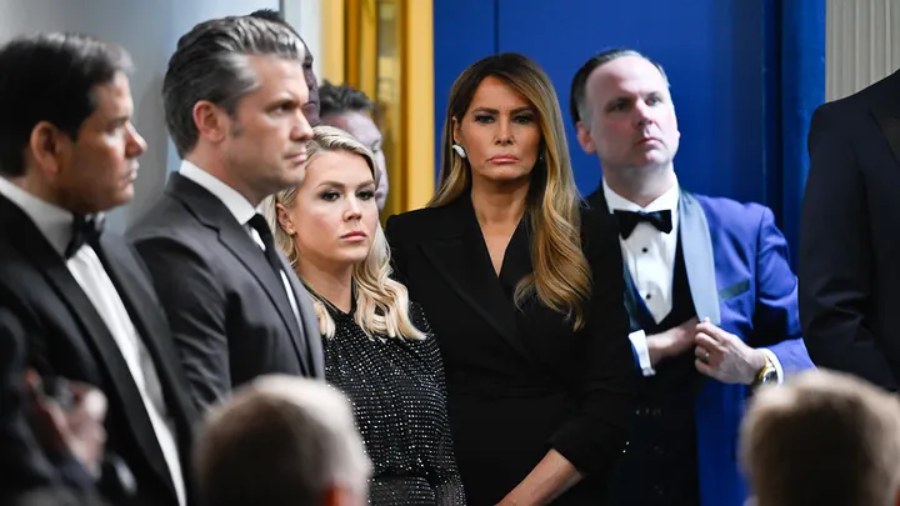
The “maximum warfare” language had already drawn sharp reaction from Republicans before Saturday’s security incident at the Washington Hilton. After the armed man charged the venue where President Trump, First Lady Melania Trump, and Vice President JD Vance were seated — and a Secret Service agent was shot but saved by a bulletproof vest — the criticism intensified considerably.
Jeffries pushed back on the premise that the phrase was his own invention. He pointed to a New York Times report from the summer of 2025 in which an anonymous White House staffer reportedly used the same words — “maximum warfare everywhere, all the time” — in describing the administration’s approach to its redistricting battle with Democrats.
“That phrase came from the White House in the summer of 2025, when they started this redistricting battle, and now they’re big mad,” Jeffries said. “Why? Because Democrats have decided to finish it. Get lost.”
The top Democrat also stated clearly that he opposes political violence in all forms — a clarification he offered while maintaining every other element of his defiant posture.
Jeffries Targets Leavitt Directly
White House Press Secretary Karoline Leavitt had used her Monday briefing to put the rhetorical debate into sharp focus.
“This hateful, constant and violent rhetoric directed at President Trump, day after day after day for 11 years, has helped to legitimize this violence and bring us to this dark moment,” Leavitt said. “When you have mentally disturbed individuals across the country who are listening to this crazed rhetoric about the president day after day after day, it inspires them to do crazy things.”
Jeffries did not receive that framing charitably.
He called Leavitt a “disgrace” and a “stone-cold liar,” rejecting what he characterized as her authority to instruct Democrats on how to speak.
“This so-called White House press secretary wants to lecture America and lecture us about civility. Get lost,” Jeffries said. “Clean up your own house before you have anything to say to us about the language that we use.”
Republicans Draw a Direct Line
The National Republican Congressional Committee (NRCC) wasted no time in characterizing Jeffries’ Monday performance as a serious political miscalculation.
“Democrats are playing with fire and pretending they don’t smell the smoke,” said NRCC spokesman Mike Marinella in a statement. “If they can’t bring themselves to put an end to this kind of rhetoric, it proves they’ll do anything to appease their far-left base.”
The framing reflects a Republican strategy that has crystallized in the days since the WHCD incident: connecting the temperature of political rhetoric from Democratic leaders to the violence that has targeted the president, and pressing Democrats to account for the relationship between the two.
Jeffries, for his part, has chosen not to accept that framing — and has made clear he intends to fight it head-on rather than accommodate it.
Florida Redistricting Joins the Fray
Beyond the rhetorical battle over language and violence, Jeffries also used Monday’s news conference to address a developing redistricting fight in Florida.
He blasted a proposed new congressional map that Florida’s Republican legislature is expected to pass in the coming days — a map Republicans say is designed to counteract the Virginia redistricting referendum that voters approved last week, which could deliver four additional Democratic House seats.
Jeffries was dismissive of the Florida effort, calling the proposed map a “DeSantis dummymander” and arguing it would not survive legal scrutiny.
“The so-called map is blatantly unconstitutional,” Jeffries said. “Florida is not going to make a meaningful difference as it relates to their efforts to rig the midterm elections. That effort has failed.
Hakeem Jeffries left Monday’s news conference having escalated rather than de-escalated the week’s central political confrontation. The “maximum warfare” phrase remains in active circulation. Karoline Leavitt has been called a “disgrace” and a “stone-cold liar.” The NRCC has responded with pointed accusations. And the redistricting battle that prompted the original language has grown more complex with the addition of Florida to the map.
In the days following an event at which the president’s security detail had to physically extract him from a ballroom, the question of whether political rhetoric has consequences — and who bears responsibility for the current temperature — has moved to the front and center of the national conversation. Both sides are now loudly making their case. Neither appears interested in turning the volume down
