

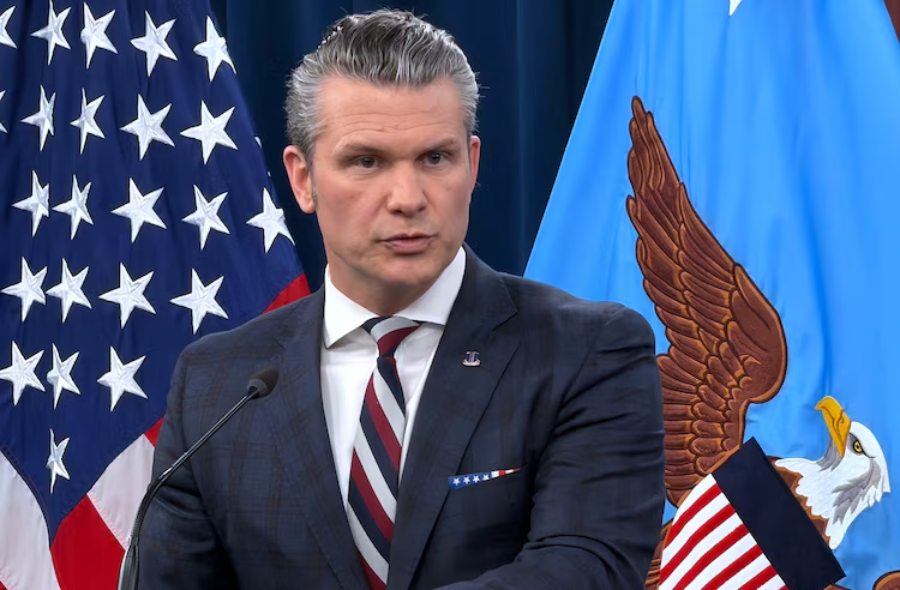
WASHINGTON — The Iranian operative who commanded the unit tasked with assassinating President Donald Trump is dead. Defense Secretary Pete Hegseth confirmed the killing Wednesday during a Pentagon press briefing, delivering the news with pointed satisfaction.
“Yesterday, the leader of the unit who attempted to assassinate President Trump has been hunted down and killed,” Hegseth declared. “Iran tried to kill President Trump, and President Trump got the last laugh.”
The announcement lands as the United States is four days into an active military campaign against Iran — and signals that settling old scores has quietly become part of the war’s mission.
Hegseth declined to name the individual killed, and was careful to note that eliminating him was never the stated objective of the broader operation. But the Defense Secretary made clear it was no accident either.
“We’ve known for a long time that Iran had intentions on trying to kill President Trump and or other U.S. officials,” he said. “While that was not the focus of the effort by any stretch of the imagination — in fact, never raised by the president or anybody else — I ensured, and others ensured, that those who were responsible for that were eventually part of the target list.”
In other words: not the mission. But not off the table, either.
A Plot That Started in 2024
The roots of the assassination scheme stretch back to the summer of 2024, when U.S. intelligence flagged a credible Iranian threat against Trump while he was still on the campaign trail. The Secret Service responded by tightening his security detail.
By November 2024, the Department of Justice had unsealed charges against an Iranian national — identified in other reporting as Farhad Shakeri, 51 — who prosecutors alleged was recruited to surveil and kill Trump. The motive, according to the DOJ, was retaliation for the January 2020 U.S. drone strike in Baghdad that killed Qassem Soleimani, the powerful commander of Iran’s Islamic Revolutionary Guard Corps — a strike that Trump himself had ordered. Iran has consistently denied any plot to kill Trump.
Trump’s personal investment in this story is no secret. In a phone call with ABC News Chief Washington Correspondent Jonathan Karl on Sunday night, the president connected the assassination plot directly to the recent joint U.S.-Israeli strike that killed Iranian Supreme Leader Ali Khamenei.
“I got him before he got me,” Trump said. “They tried twice. Well, I got him first.”
Hegseth, reflecting on the sinking of an Iranian warship — named, pointedly, the Soleimani — allowed himself a moment of dark humor: “Looks like POTUS got him twice.
Beyond the assassination plot revelation, Wednesday’s briefing carried another significant milestone. Hegseth announced that a U.S. submarine had torpedoed and sunk the Iranian warship Soleimani in the Indian Ocean — marking the first time an American submarine has sunk an enemy vessel since World War II.
The symbolism was impossible to miss. The ship named after the IRGC general whose killing sparked years of Iranian retaliation threats now rests on the ocean floor — sent there by the country that killed him.
What This Means
The killing of the assassination plot’s architect does more than settle a personal score. It signals that the current U.S. military campaign against Iran is not confined to declared strategic objectives. Targets tied to threats against American officials — including the president — are being pursued in parallel.
For Iran, whose leadership has already suffered the killing of Supreme Leader Khamenei and the sinking of a naval vessel, this week represents a cascade of losses. For the Trump administration, it is a calculated exercise in demonstrating consequences.
As Hegseth put it Wednesday: this is “not a mission accomplished situation.” It is, he said, “a reality check.”
