

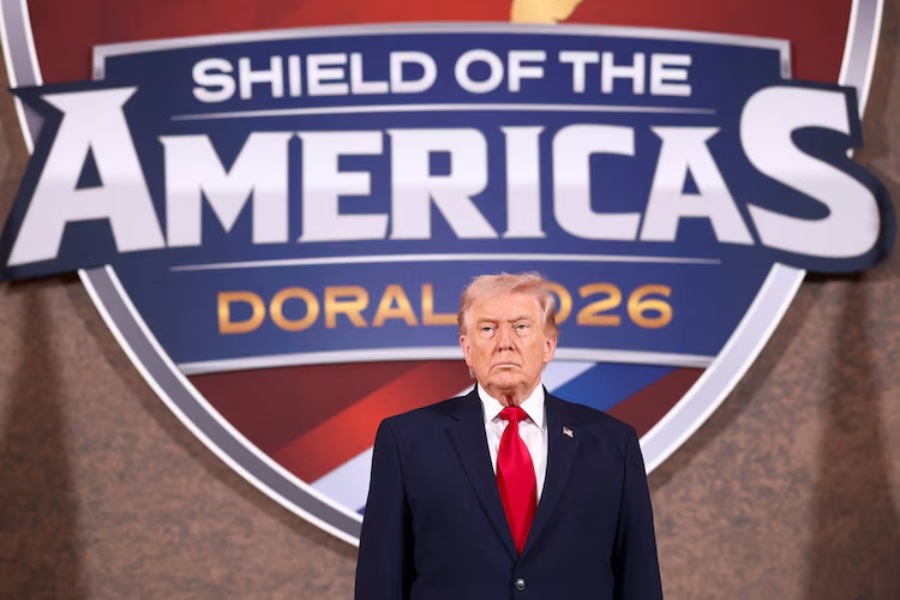
DORAL, Fla. — President Donald Trump stood before a coalition of Latin American and Caribbean leaders Saturday and delivered a blunt message to Cuba: its days under the current regime are numbered.
Speaking at the “Shield of the Americas” summit hosted at Trump National Doral, Trump declared that Cuba sits “at the end of the line” — a nation he described as broke, isolated, and ideologically bankrupt. The warning followed what the White House has positioned as a historic milestone: the capture of former Venezuelan President Nicolás Maduro.
“Cuba’s in its last moments of life as it was,” Trump told the assembled heads of state. “It’ll have a great new life, but it’s in its last moments of life the way it is.”
The summit drew leaders from more than a dozen nations, including Argentinian President Javier Milei, Bolivian President Rodrigo Paz Pereira, Chilean President-elect José Antonio Kast, Salvadoran President Nayib Bukele, Panamanian President José Raúl Mulino, and Honduran President Nasry Asfura, among others.
Trump used the gathering to formally sign a proclamation launching the Americas Counter Cartel Coalition — a multilateral commitment to deploy lethal military force against drug trafficking organizations and terrorist networks operating across the hemisphere.
“The heart of our agreement is a commitment to using lethal military force to destroy the sinister cartels and terrorist networks once and for all,” Trump said. “We’ll get rid of them. We need your help.”
The White House framed the coalition as a direct outgrowth of the Maduro capture, asserting that member nations are aligned with Washington on border security and cartel dismantlement.
Trump Touts Military Strength — From Venezuela to Iran
The president used his remarks to broadly showcase U.S. military capability under his second term, drawing a direct line between the January raid that seized Maduro in Venezuela and what he described as ongoing action in Iran.
“I built the military and rebuilt it and made it really strong,” Trump said, adding that his administration is now “using it.”
Trump told the assembled Western Hemisphere leaders that U.S.-Israeli military operations against Iran were progressing well, calling it “a pretty wild time” but one that is “going very well.” The summit took place amid ongoing volatility in U.S. energy markets linked to the Iran conflict.
One of the summit’s more consequential subplots involved the formal repositioning of Kristi Noem, who is departing as Secretary of Homeland Security effective March 31 and transitioning into a newly created role as Special Envoy for “The Shield of the Americas.”
Noem was present at the summit alongside Secretary of State Marco Rubio, Commerce Secretary Howard Lutnick, and Defense Secretary Pete Hegseth — but notably, Trump did not mention her by name when he personally acknowledged and thanked his Cabinet members in attendance.
It was Rubio who formally introduced her to the assembled leaders, telling them, “You will see a lot of her.”
Noem, for her part, leaned into the diplomatic mission ahead of her, offering every leader in the room her personal cell phone number.
“So that you can reach me at any time that you may need something, and we’ll work together to continue to make sure that our relationship is a shield to the Americas,” she said.
In an overnight email to DHS staff, Noem wrote that her new role would allow her to build on “the new partnerships and national security expertise” she developed as department secretary. Trump had promised more details about her role at the summit, but offered none during the event itself.
Strained Relationships — and a Notable Reconciliation
Trump’s relationship with several Latin American leaders has been rocky. His administration drew sharp criticism from some regional governments over the January raid that captured Maduro, with certain leaders condemning it as a violation of Venezuelan sovereignty.
Relations with Colombian President Gustavo Petro had also frayed publicly — but the two appeared to turn a page following the Venezuela operation. Trump subsequently invited Petro to the White House, and both sides issued warm statements signaling a reset. Petro’s attendance at the Doral summit underscored that thaw. [Suggested Link: U.S.-Colombia relations under Trump]
Trump also used the summit to praise Defense Secretary Pete Hegseth in characteristically direct terms.
The Doral summit signals a sharpened, more interventionist U.S. posture across the Western Hemisphere — one that pairs diplomatic coalition-building with explicit military threats against adversaries in Venezuela, Cuba, and beyond.
Whether the Americas Counter Cartel Coalition translates into coordinated action — or remains largely symbolic — will depend on how member nations navigate the competing pressures of U.S. partnership and domestic political constraints. Cuba, for its part, has been put on formal notice. The White House appears to be betting that momentum from Venezuela carries forward.
