

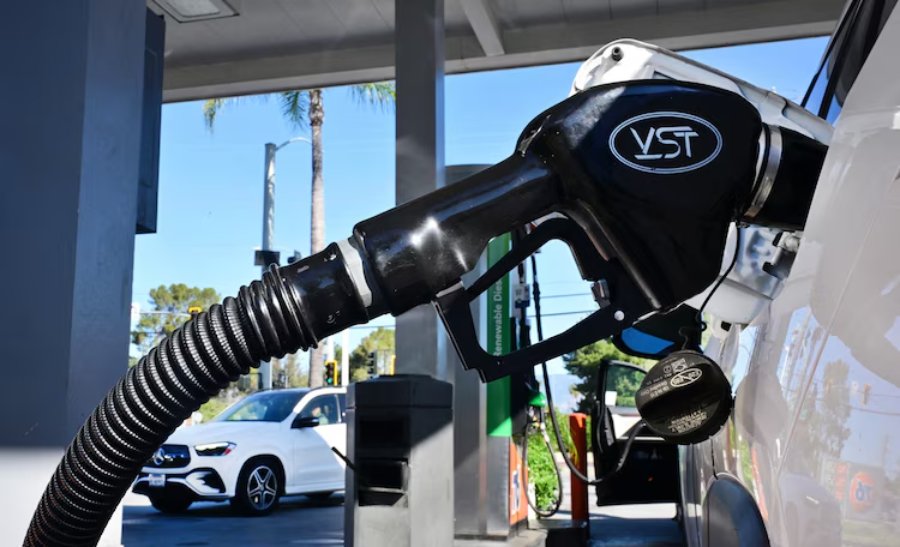
Ten days into the U.S. military campaign against Iran, the economic shockwaves are hitting American wallets hard. Gas prices have surged to a national average of $3.47 per gallon as of Monday — a jump of nearly 50 cents in just one week, according to AAA data. Oil markets, meanwhile, briefly pushed past $100 a barrel for the first time since Russia launched its invasion of Ukraine in 2022.
For a president who built much of his domestic brand on cheap energy, the numbers are politically inconvenient. Yet President Donald Trump is not treating them as a crisis.
In a Sunday interview with ABC News Chief White House Correspondent Mary Bruce, Trump brushed aside the economic turbulence with characteristic confidence.
“I think it’s fine. It’s a little glitch. We had to take this detour,” the president said, before pivoting to praise the U.S. military’s campaign against Tehran.
That same night, Trump took to social media to make a broader argument: that short-term oil price pain is a worthwhile trade-off for eliminating what he described as Iran’s nuclear threat.
“Short term oil prices, which will drop rapidly when the destruction of the Iran nuclear threat is over, is a very small price to pay for U.S.A., and World, Safety and Peace,” Trump posted.
The message is clear — the administration views the price spike as temporary and justified. But for millions of Americans filling their tanks, the math feels anything but small.
From $1.99 to $3.50: A Stark Reversal
The price surge arrives at a particularly awkward moment for the White House. As recently as February 24, Trump was celebrating low gas prices during his State of the Union address.
“Gasoline, which reached a peak of over $6 a gallon in some states under my predecessor and was, quite honestly, a disaster, is now below $2.30 a gallon in most states, and in some places $1.99 a gallon,” Trump told Congress last month.
That talking point has aged poorly. Prices are now closing in on $3.50 a gallon and are expected to keep climbing as long as the Middle East conflict continues — a far cry from Trump’s 2024 campaign promise to push gas below $2 a gallon.
Patrick De Haan, a petroleum analyst at GasBuddy, says Americans are already experiencing “sticker shock” — and the worst may not be over yet.
“Gas stations are seeing their costs go up in real time again today, as oil markets are jumping, and that’s going to be another round of price increases over the course of this week,” De Haan warned. He projected that gas prices could jump an additional 15 to 35 cents per gallon within just three days.
The outlook for diesel is even grimmer. De Haan cautioned that diesel could surge 35 to 50 cents per gallon, potentially pushing the national average close to $5 a gallon — a development that would ripple through supply chains, transportation costs, and consumer prices broadly.
De Haan also made clear that resolution won’t bring instant relief. “Every day the situation continues, it could add another several weeks to the recovery time,” he told reporters.
A central driver of the oil price anxiety is the Strait of Hormuz, through which an estimated 20 million barrels of oil pass daily. The widening conflict has disrupted that flow, and several war-risk insurers have pulled coverage for vessels navigating the waterway.
Trump addressed the bottleneck in a Sunday interview with Brian Kilmeade, telling ships to “show some guts” and push through the channel. He added that the U.S. government would provide risk insurance and guarantees for tankers, and that the U.S. Navy would escort vessels through the strait if necessary.
Analysts have noted that while the Strategic Petroleum Reserve (SPR) could offer some short-term market relief, it is unlikely to compensate for the volume of oil currently being blocked from global markets.
Democrats Pounce; Republicans Hold the Line
The price spike has handed Democrats a ready-made political weapon, and they are using it.
Senate Minority Leader Chuck Schumer called on Trump to release oil from the Strategic Petroleum Reserve to ease the burden on American families. “American families are suffering from higher prices as the effects of Trump’s reckless war become pain at the gas pump and beyond,” Schumer said in a statement Sunday.
House Minority Leader Hakeem Jeffries was equally pointed, writing on X: “Trump promised a Golden Age in America. Meanwhile, Republicans are crashing the economy, gas prices are out of control and the extremists are spending billions dropping bombs in the Middle East. You deserve better.”
Trump, when asked whether he would tap the SPR, declined to commit — instead criticizing former President Joe Biden for drawing down the reserve during the 2022 energy crisis stemming from Russia’s war on Ukraine.
“Biden used them so that he could get some extra votes in the election,” Trump said aboard Air Force One on Saturday.
Most Republicans, for now, are backing the president’s wait-and-see posture. Sen. John Kennedy predicted prices would fall once military objectives in Iran are achieved — offering a timeline tied entirely to the war’s outcome. The economic stress is showing up in public opinion data. A NBC News poll released Sunday gave Trump his lowest approval ratings on economic issues, with just 36% of registered voters approving of his handling of inflation and cost of living, versus 62% who disapproved.
On Iran itself, 54% of registered voters disapproved of Trump’s handling of the conflict.
Those numbers carry particular weight heading into the 2026 midterm elections, where Republicans are defending narrow majorities in both chambers of Congress. Cost of living was a decisive issue in 2024 — and it shows every sign of remaining so. That is perhaps the most consequential open question. Trump initially estimated the campaign would last four to five weeks, before walking that back with a more open-ended commitment to “whatever it takes.”
On Sunday, the president offered his most recent assessment: “I don’t know. I never predict. All I can say is we are ahead of schedule both in terms of lethality and in terms of time.”
For American consumers, however, GasBuddy’s De Haan’s warning carries equal weight: the longer the conflict persists, the longer it will take for prices to recover — and each passing day pushes that timeline further out.
The U.S.-Iran conflict has introduced an unwelcome variable into Trump’s domestic economic narrative. Gas prices that were a signature achievement just weeks ago have become a liability, and the administration’s response — patience, optimism, and a promise that relief is coming — may not be enough to hold back political fallout if prices continue their climb. With midterms on the horizon and public approval eroding on both economic and foreign policy fronts, the “glitch” Trump is dismissing could prove costlier than he is letting on.
