

Cinco de Mayo arrives each year with a predictable rhythm in American politics — and for the past decade, a central question has been: what will Donald Trump post?
On Tuesday, the answer was a stylized “NICE” graphic shared to Truth Social — an eagle-and-shield design styled to resemble federal law enforcement branding, referencing his recently endorsed concept of renaming Immigration and Customs Enforcement to “NICE.”
It is the kind of post — blending humor, immigration policy, and cultural provocation — that has made Trump’s Cinco de Mayo messaging a recurring annual event in the American political calendar.
The ‘NICE’ Branding — and How It Got Here
The “NICE” concept did not originate with Trump. It began as a social media suggestion — one that caught the president’s attention and received his immediate, characteristically emphatic endorsement in a late April Truth Social post.
“GREAT IDEA!!! DO IT,” Trump wrote, amplifying the idea of rebranding ICE under a new acronym.
Tuesday’s Cinco de Mayo post gave the concept a visual form: an eagle-and-shield image above the letters “NICE,” designed in a style deliberately echoing official federal enforcement branding.
The timing — pairing immigration enforcement messaging with a Mexican cultural holiday — reflected the same impulse that has driven Trump’s Cinco de Mayo posts for the better part of a decade: a willingness to use the occasion for political commentary as much as celebration.
The Post That Never Gets Old
Whatever the “NICE” graphic generates in the current news cycle, it is almost certain to share attention online with a photograph that has now been circulating for ten years — and shows no signs of losing its hold on the internet.
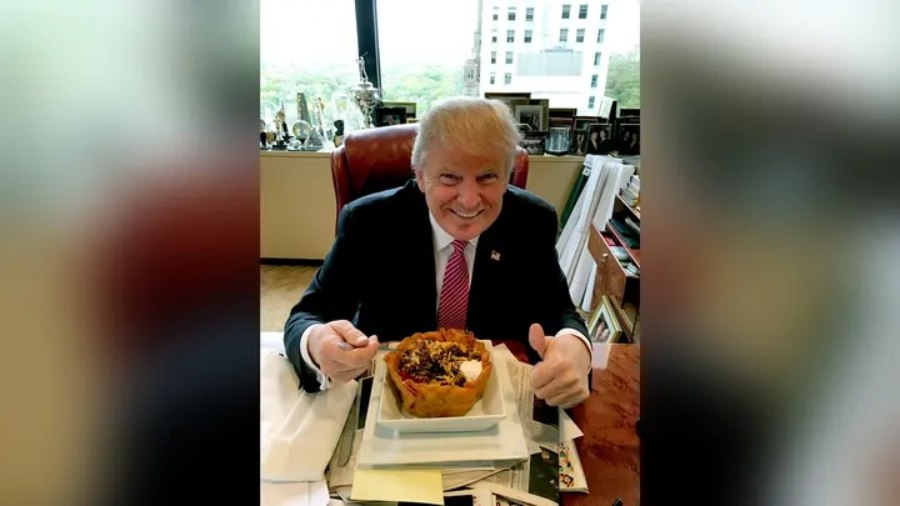
In 2016, then-candidate Trump posted a photograph of himself seated at his desk at Trump Tower, taco bowl positioned in front of him, giving a thumbs up to the camera. The caption read: “Happy #CincoDeMayo! The best taco bowls are made in Trump Tower Grill. I love Hispanics!”
The post went viral immediately. It has continued to resurface every May 5 in the years since — reliably, almost ritually — as social media users rediscover or reshare it as a cultural artifact of the Trump political era.
Last year, Trump leaned into the tradition himself, resharing the original image with the caption: “This was so wonderful, 9 years ago today!”
The annual return of the taco bowl post has developed its own commentary ecosystem.
“Cinco de Trumpo,” one user wrote this year, alongside a repost of the original image.
“Such a classic,” another offered.
A third staked out a more ambitious claim: “Maybe the greatest tweet of all time.”
A Tradition Built on Provocation
Trump’s Cinco de Mayo posts have never been purely celebratory in the conventional political sense. From the 2016 taco bowl — which critics called tone-deaf and supporters called unpretentious — to this year’s immigration-branded graphic, they have consistently occupied a space where cultural acknowledgment and political messaging coexist uncomfortably, generating exactly the kind of engagement that has defined his presence on social media for more than a decade.
Whether that combination reads as clever, crass, or simply characteristically Trump tends to depend entirely on who is looking at it.
What is consistent is that each year’s post gets attention — and that the 2016 taco bowl photograph, now a decade old, remains arguably the most durable single social media artifact of his political career.
The White House did not respond to Fox News Digital’s request for comment on Tuesday’s post.
Cinco de Mayo 2026 gave President Trump another opportunity to do what he has done with the holiday every year since 2016: use it as a canvas for something that generates attention, reaction, and argument. The “NICE” post will produce its own cycle of commentary. The taco bowl photo will resurface again regardless, as it does every year, greeted by a fresh round of people calling it “a classic.” Whatever one thinks of the politics involved, the consistency is remarkable: ten years in, Trump’s Cinco de Mayo presence on social media remains one of the more reliable annual events in American political culture.
