

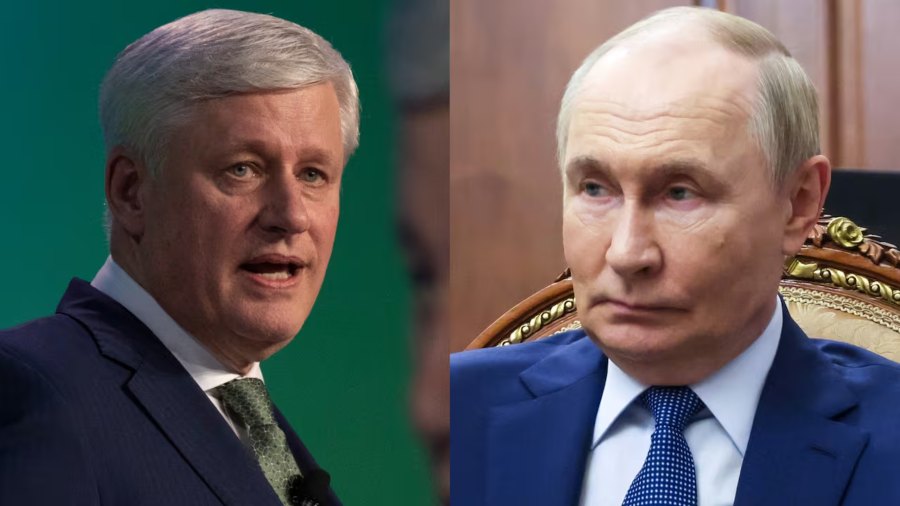
There’s a question buried under all the footage of burning tanks and shattered buildings that nobody in Washington wants to answer honestly: why isn’t Putin doing more?
Not why isn’t he winning—we know the answers to that, or think we do. Bad planning, poor logistics, corrupt supply chains, overconfidence, yes-men telling the boss what he wants to hear. All true, all documented, all contributing to a campaign that looks nothing like the blitzkrieg the Kremlin imagined.
But here’s the part that doesn’t fit the narrative: if Putin wanted to level Ukraine, he could. The Russian air force hasn’t been grounded. The missiles haven’t run out. The heavy bombers are still sitting on their tarmacs, fully capable of turning Kyiv into Grozny circa 1999 or Aleppo circa 2016. We’ve seen what Russia does when it decides to destroy a city. We’re not seeing that here.
William Arkin, who’s forgotten more about national security than most Pentagon officials will ever learn, talked to intelligence professionals and came away with a different picture. Russia is causing less damage and killing fewer civilians than it could. That’s not an accident. That’s a choice.
Think about what that means.
If Russia leveled Ukrainian cities, if it conducted the kind of all-out bombardment the Biden administration keeps warning about, the clamor for NATO intervention would be deafening. Every network would run body counts. Every politician would demand action. Every ally would press for escalation. Putin would get exactly what he doesn’t want: a wider war with a better-armed enemy.
Instead, he’s fighting with one hand tied. Taking enough territory to have something to negotiate with. Putting the Ukrainian government in a position where they have to deal. Leaving himself a way out.
This is not the portrait of a madman. This is the calculus of a man who knows he’s in a bad spot and needs to find an exit before the situation gets worse.
The deeply flawed execution we’re watching—the stalled columns, the lost equipment, the humiliating sinking of the Moskva—obscures this larger reality. Putin’s generals may have failed him. His intelligence may have been garbage. His logistics may be a nightmare. But the restraint is intentional.
The question is whether anyone in Washington sees it that way. The official narrative requires a monster, someone beyond reason, someone whose only motivation is destruction. That narrative justifies the weapons shipments, the sanctions, the endless posturing about democracy versus tyranny. It also makes it impossible to see what’s actually happening: a war that both sides are losing, with no clear off-ramp for anyone.
Putin may be holding back. But holding back isn’t winning. And the longer this drags on, the harder it becomes for either side to stop.
The Russian military’s failures are real. The Ukrainian resistance is real. The suffering is real. But so is the possibility that Putin never intended to destroy Ukraine—only to bend it, break its resistance, and bring it back into Russia’s orbit by whatever means necessary. That goal hasn’t changed. The methods have just proven catastrophically inadequate.
Now we’re in a different phase. Russia is adapting, slowly and painfully. Ukraine is bleeding, bravely and relentlessly. And somewhere in the Kremlin, a man who thought this would take three days is calculating how to salvage something from the wreckage of his plans.
The bombing could get worse. It probably will. But if it hasn’t happened yet, there’s a reason. And that reason is not kindness.
