

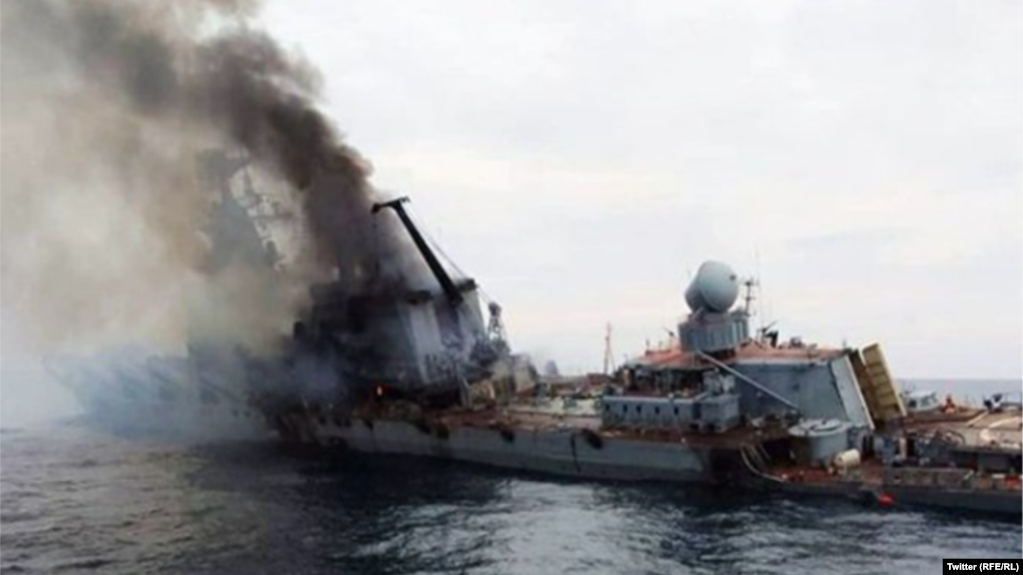
It’s tempting to watch the Moskva slip beneath the Black Sea and feel a little thrill of satisfaction. The Russian flagship, pride of Putin’s navy, either taken out by Ukrainian missiles or consumed by its own catastrophic incompetence. For anyone watching this war with hope for the defenders, it’s a moment worth savoring.
But savor it too long, and you might miss what it says about us.
The same vulnerabilities that sent a Russian cruiser to the bottom exist in every navy, including ours. Maybe especially ours.
For years now, the reports have piled up like unpaid maintenance requests. The collisions involving USS John S McCain and USS Fitzgerald in 2017 weren’t aberrations. They were symptoms. Ships running into things because exhausted crews couldn’t see straight. Destroyers limping into port with systems failing because parts had been on backorder for two years. Sailors cannibalizing one ship to keep another marginally operational, a desperate practice that leaves the donor vessel effectively dead in the water.
The Government Accountability Office laid it out in February with the grim precision of an autopsy. Crews can’t get basic supplies. Electrical safety equipment takes twenty-four months to arrive. Filters, oil, protective clothing—the mundane necessities of keeping a warship at sea—are increasingly unobtainable. Sixteen ships surveyed, ten admitted to stripping parts from sister vessels just to stay afloat.
This is the most powerful navy in the world? On paper, maybe. In reality, it’s a fleet running on fumes and borrowed time.
One former assistant defense secretary put it bluntly last year: the Navy is on the verge of strategic bankruptcy. Not enough ships for global demands. Not enough readiness to meet those demands safely. Not enough surge capacity for actual emergencies. The debts are coming due, and when they do, it may happen suddenly and violently.
Now add missiles to the equation.
The Moskva, if the Ukrainians did sink it with a Neptune missile, represents a category shift. A relatively modern warship, with air defense systems and countermeasures, taken out by a weapon designed for exactly that purpose. This is the tank versus anti-tank race playing out at sea. Every time a missile finds its target, the doubt spreads: are we building the wrong ships for the right war?
America’s fleet is built around carriers. Floating cities, nuclear-powered, carrying seventy aircraft and five thousand souls. They are magnificent expressions of national power. They are also, potentially, magnificent targets. China has spent two decades building anti-ship ballistic missiles designed specifically to kill them. The question isn’t whether those missiles work. The question is whether we’ll find out the hard way.
But the hardware problem, as serious as it is, may not be the deepest one.
After the Battle of Savo Island in 1942, when the Navy suffered one of its worst defeats, Admiral Turner conducted a brutal assessment. He didn’t blame technology or intelligence failures or bad luck. He blamed attitude.
The Navy, he concluded, was obsessed with its own superiority. Officers and men despised the enemy, assumed victory in all circumstances, and let confidence curdle into complacency. The result was a fatal lethargy of mind—a routine acceptance of peacetime standards in a wartime environment. Turner believed this psychological factor mattered more than even the surprise of the attack.
Read that again. A man who lost ships and sailors by the thousand said the real problem was thinking you couldn’t lose.
Eighty years later, here we are again. The Moskva is gone, and somewhere in the Pentagon, people are running calculations about missile trajectories and ship hardening and next-generation defenses. All necessary. All important.
But the deeper lesson is the one that keeps getting learned and forgotten, relearned and ignored. It’s the lesson about arrogance. About the assumption that technology guarantees victory. About the belief that the other side is too backward, too poorly trained, too incompetent to pose a real threat.
The Japanese weren’t too backward in 1942. The Chinese aren’t too backward now. And the Russians, for all their struggles in this war, just demonstrated that a single missile can undo a flagship.
The Navy will study the Moskva. It will update its tactics, revise its training, maybe accelerate some procurement programs. That’s what bureaucracies do.
But unless it also finds a way to kill the complacency, the lethal lethargy of mind that convinces good sailors they’re invincible, the next lesson may come much harder.
Admiral Turner understood it. His successors would do well to remember.
