

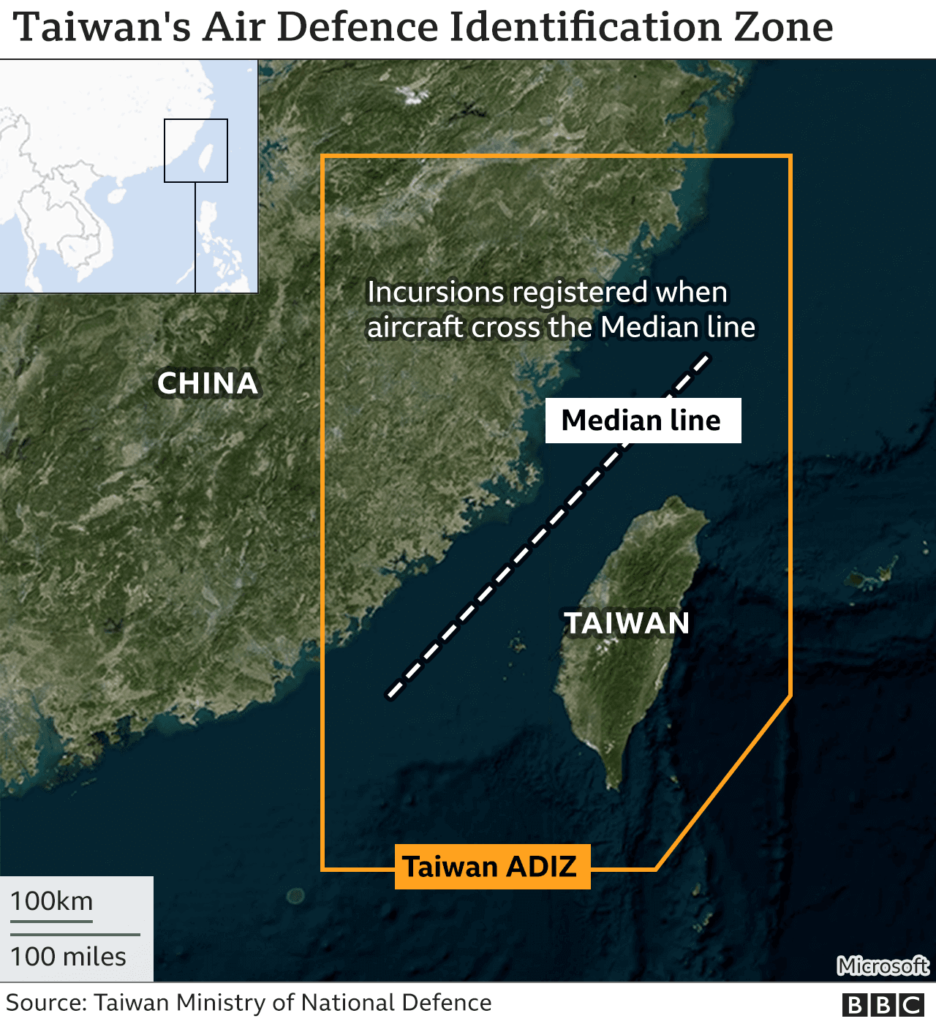
Every time dozens of mainland fighter jets scream into Taiwan’s air defense zone, Taipei scrambles its own aircraft. And every time, the world holds its breath, hoping a misunderstood signal doesn’t become a funeral pyre.
The BBC frames it as a question of intentions: Is Beijing building toward invasion? Are the patriotic movies softening public opinion? Did Xi really promise Biden he wouldn’t do it?
These are the wrong questions.
The only question that matters—the one whispered in Situation Rooms and buried in presidential briefings—is this: Would the United States go to war with a nuclear-armed China over Taiwan?
Not economic war. Not sanctions. Not diplomatic isolation. Actual war. The kind where aircraft carriers sink, cities burn, and the word “escalation” becomes a euphemism for extinction.
Let’s stop pretending this is a grad school seminar.
The Strategic Ambiguity Trap
Washington loves “strategic ambiguity.” It sounds sophisticated. It keeps everyone guessing. It allows presidents to make promises they might not have to keep.
But ambiguity cuts both ways. If Beijing genuinely believes the U.S. commitment is hollow—that no American president would sacrifice Los Angeles for Taipei—then the calculus shifts. Why not move? Why not unify the motherland and call the bluff?
Unless it’s not a bluff.
Here’s the unspoken truth: If the Biden administration’s ambiguity is actually cover for a “rock-solid” determination to defend Taiwan at all costs, and if Beijing ever concludes that invasion is the only path forward, then the United States faces a logical conclusion so terrible that no one wants to say it out loud. A pre-emptive strike against all known Chinese nuclear weapons sites.
All of them.
The targeting is already done. You can be certain of that. Every silo, every mobile launcher, every submarine base—plotted, mapped, memorized. The “football” that follows the president everywhere contains options that would make Hiroshima look like a firecracker.
This is not alarmism. This is not hyperbole. This is what “rock-solid commitment” means when the other side has ICBMs pointed at your cities.
The Arguments That Don’t Matter
“But China’s economy is struggling!”
“But the Olympics!”
“But sanctions!”
These are the arguments of people who have never sat in a room where the unthinkable becomes the only option. When survival is on the line, GDP doesn’t matter. Olympic prestige doesn’t matter. Sanctions don’t matter. Only one thing matters: Does the other side believe you’ll do it?
The Nuclear Question
Would the United States go to war with a nuclear power over an island 100 miles off the Chinese coast?
The honest answer: We don’t know. And neither does Beijing.
That’s the terrifying heart of this crisis. The ambiguity that was supposed to prevent war might actually cause it—because both sides are guessing, both sides are gambling, and both sides are preparing for outcomes that no one wants to imagine.
China sees Taiwan as a core interest, non-negotiable, historical destiny. The United States sees its credibility, its alliances, its role as global hegemon on the line. Both are willing to bleed. Both have the capacity to end civilization.
I’ve spent my life in rooms where the choices were never good, only less bad. And the lesson I’ve learned—the only one that matters—is this:
Plan for the worst. Hope for the best.
The worst is very, very bad. It’s not tanks on a beach. It’s not another Afghanistan. It’s the end of the world as we know it, written in missile silos and submarine patrols and presidential decisions made in three minutes with incomplete information.
The best is that both sides know this. That somewhere, in Beijing and Washington, sane people are doing everything possible to ensure the question never has to be answered.
But hoping isn’t planning. And planning means looking at the nuclear question without flinching.
Would the US go to war with China over Taiwan?
If you’re in Beijing, you have to assume yes. If you’re in Washington, you have to assume no. And somewhere in that contradiction, tragedy waits.
The only way out is the hard way: direct communication, mutual respect for core interests, and a shared understanding that some lines, once crossed, can never be uncrossed.
The jets will keep flying. The scrambles will continue. And every time, we’ll hold our breath.
Because the alternative is unthinkable.
Until it isn’t.
